

Jane Austen, Music, and Me
I was named after Jane Austen by my mother—her favourite writer, who soon became mine. As a teenager, I devoured every Austen novel, reading and re-reading them dozens of times. To this day, I return to them like dear friends. Fanny Price, Anne Elliot, Lizzie Bennet, Emma Woodhouse, Charlotte Lucas—all of them live within me. Perhaps in true theatrical fashion, like Bottom in A Midsummer Night’s Dream, I want to play every part. Sometimes – now in full currently fashionable transgender mode – I even at times feel I am Wickham, Henry Crawford… or on good days Fitzwilliam Darcy.
[As a teenager I once translated the latter part of Darcy’s letter into French as a covert declaration of love to a teenage crush… the crush thankfully understood the reference and we remained lifelong friends!]
Austen’s female characters are some of the most defining figures in literature. Their brilliance, wit, courage, and flaws resonate with me deeply. Each time I reread them, I feel they are telling my own story—and I fiercely identify with their journeys of growth, discovery, and the delicate dance between truth and self-delusion.
I love imagery, witty wordplay and irony in language. My great aspiration is to be a wordsmith, in the way that I have learnt to be a shape-shifter within the phrasing of my flute playing. Jane Austen is the master—she is my mistress. How lovely!
Jane Austen’s Voice in Music
My love of Austen has always intertwined with my music. Her innovative, free, and direct style reminds me of French flute playing—the inflections, the conversational meanderings of a line, the way narrative unfolds musically and allows each listener their own interpretation.
In music, as in Austen’s prose, there is a continual act of revision. Each practice, each performance, strips away ego and illusion, striving toward a universal truth. Tony Tanner once said that Pride and Prejudice is “a drama of re-cognition”—the mind revisiting, revising, and finally seeing things as they are. Music is much the same.
For me, playing the flute is not simply about sound—it’s about storytelling, dialogue, and connection.
Ruth Wilson: A Friend, Mentor, and Inspiration
Recently, the universe brought me back into the orbit of Ruth Wilson—a woman who has been like a fairy godmother in my life. Her presence is profoundly consoling.
Ruth and her remarkable generation—my parents’ generation—were fiercely clever, cultured and creative. Polymaths who revered knowledge, beauty, literature, and the best of Western civilisation, all the while never shying away from challenging its injustices. As a child, I was privileged to move among their circle, thanks to my mother Anne [Shipton] Rutter’s involvement in the brilliant semi-professional theatre group called Graduate Theatre. Made up of Sydney University graduates, – former Sydney University Dramatic Society [SUDS] members, they included: Arthur Dignam, Richard Bradshaw, Maggie Blinco, Val Donlon, Brom and Arianthe McKillop, Olive Wood, Allan Kendall, Ted and Hilary Linstead, Charles Cooper, Philip Kitley, David Mitchell, Ruth Wilson, David Wilson, and Terence Clarke.
Stage-struck, I spent hours at rehearsals, helping backstage, ushering, turning music pages, playing child roles—anything just to be part of the magic.
That Graduate Theatre World introduced me to extraordinary people, including Don Burrows (commissioned to write incidental music for The Man of Mode), who later became my teacher. At the heart of That Graduate Theatre hub was Ruth—curious, brilliant, generous of spirit, while at home in my bedroom was the company of Jane Austen and her characters…
(Under the bedcovers after lights out, the torch clearly shining through the blankets…indeed both my parents were avid readers, and I think they turned a blind eye to this literary disobedience au lit)
At 89, Ruth achieved something astonishing: earning her PhD and publishing The Jane Austen Remedy. What an inspiration for all of us! Her book is warm, wise, and impossible to put down.
Music for Jane Austen
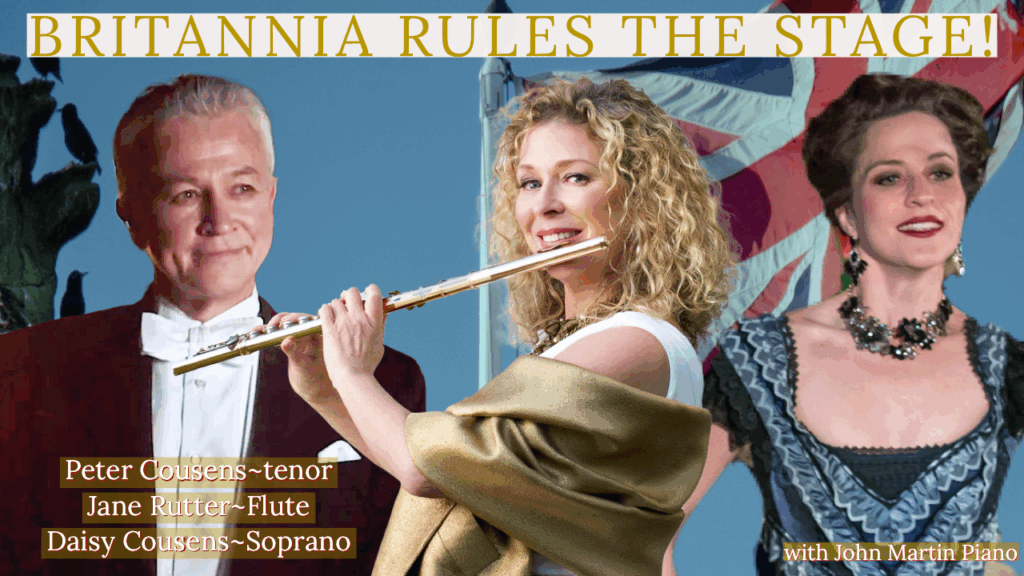
For Ruth’s book launch, I created a new solo flute arrangement of Robin Adair—which I have only ever performed once, in my concert Series Live at Lunch at the Concert Hall of the Concourse Sydney Australia. A programme entitled Britannia Rules the Stage.
Robin Adair is the only piece of music Jane Austen ever explicitly mentioned in her novels. In Emma, Jane Fairfax plays it as a brilliantly coded message of love to Frank Churchill, proof of Austen’s wit and her deep understanding of the hidden power of art, and of music’s power to communicate.
I am delighted to say that at the Jane Austen Society of Australia’s 2025 Christmas celebration, I will perform the arrangement – for the second time ever. Alongside the performance, I’ll be sharing some thoughts on Austen’s heroines, the curious relationship between Charlotte Lucas and Lizzie Bennet, and my own lifelong bond with Austen’s works.
Adversity has always been woven through Jane Austen’s life and work, even as her novels sparkle with wit and optimism. She never married in a world where a woman’s security depended on a good match, and after her father’s death she, her sister Cassandra, and their mother experienced genuine financial precarity and repeated moves that left them dependent on the goodwill of relatives.
Ill health shadowed her final years; she wrote through increasing weakness and pain, completing masterpieces like Persuasion while her body quietly failed her, before dying at just 41. Yet from these constraints and disappointments she forged a powerfully independent inner life, creating heroines who learn to see clearly, to laugh, and to keep loving in spite of loss and limitation.
In a very different era, adversity has also somewhat marked my path, deepening rather than diminishing my artistic voice. A serious car accident left me in a brief coma and caused very minor brain damage. Medical advice urged me to slow down and reduce my workload.
Refusing to let this setback define me, I chose instead to live and create with even greater intensity: I have now released my 27th solo flute album and, over the last decade, have produced and starred in hundreds of concerts, continuing to share my music with undimmed passion.
Like Austen, I know that vulnerability and limitation can sharpen, rather than blunt, the courage to tell the truth; adversity becomes not a full stop, but a surprising modulation, out of which a richer, more resonant melody emerges.
Why Austen Matters
Jane Austen is more than a novelist to me. She has been a guide, a mirror, and a friend. Her characters illuminate my own self-illusions and help me embrace the humility of recognising mistakes, just as Emma and Lizzie do. She has influenced my art, my stagecraft, and even my delight in burlesque and cabaret, with their love of caricature and pastiche.
When I was a teenager, my mother caught me reading Victoria Holt novels, with gentle disdain, she handed me Pride and Prejudice instead. I gobbled it up and soon devoured Austen’s entire body of work—a diet I’ve never truly abandoned. And for that, and for being named ‘Jane,’ I will always thank her.
Austen’s voice runs like a melody through my life—and when I play the flute, I feel we are having a conversation that spans centuries.
Thank you, Ruth, for reminding us that at any age we can live, learn, and create boldly.
Jane Austen’s voice has always been with me—in my reading, my performing, and in the way I strive to connect honestly with audiences. the writer who has shaped me and even my name.
Thank you, Jane Austen, for shaping my art, my imagination and my voice as both musician and woman. And thank you, dear Mum, for giving me both my name and my first Austen novel.
With love
—Jane Rutter